
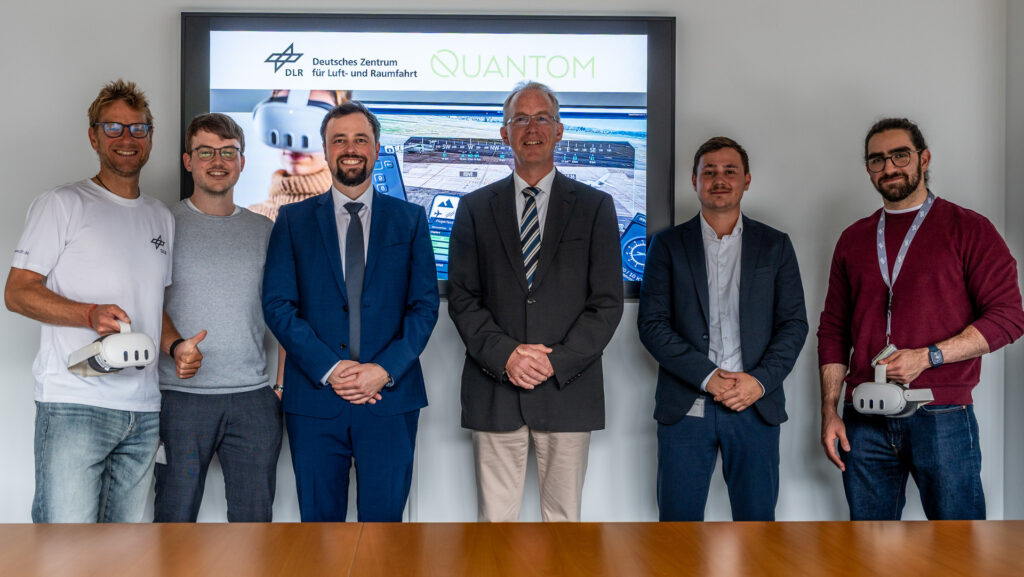
The German Aerospace Center (Deutsches Zentrum für Luft- und Raumfahrt, DLR e.V.) and technology company QUANTOM are joining forces to bring an innovative solution for air traffic services at smaller and regional aerodromes into practical use. The collaboration builds on a Virtual Tower concept developed at the DLR Institute of Flight Guidance in Braunschweig, Germany, which QUANTOM will now further develop into a commercially viable product.
“The Virtual Tower concept enables air traffic controllers and flight information service officers (AFISO) to provide services to aerodromes remotely, without being tied to a permanently equipped Remote Tower workstation,” explains Jörn Jakobi from the DLR Institute of Flight Guidance. “Instead of requiring extensive screen and hardware infrastructure, the view to the aerodrome, relevant systems and control functions are integrated into a virtual working environment and made accessible via virtual reality (VR) headsets,” Jakobi continues.
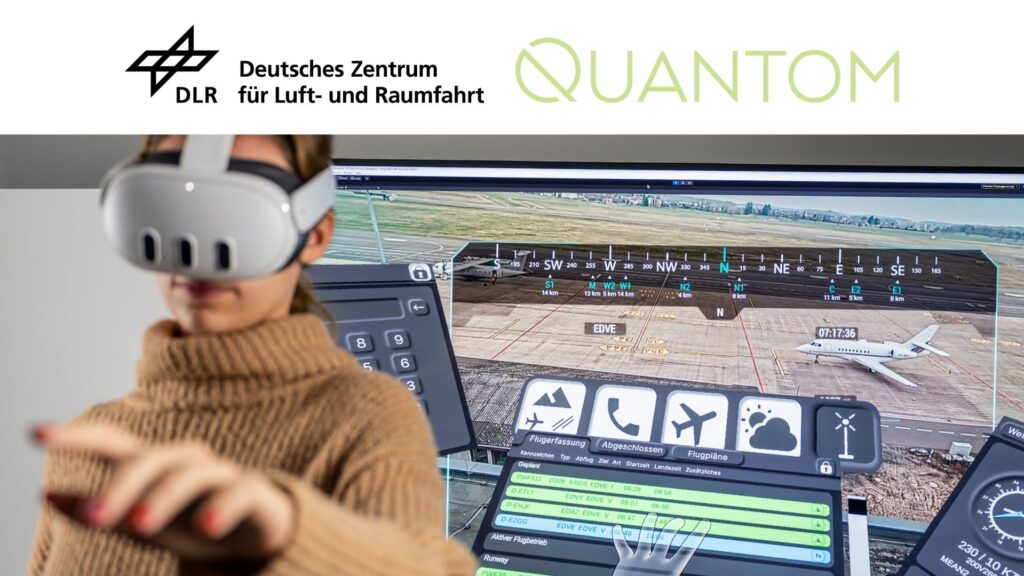
Transforming the Remote Tower into a Virtual Workstation
Remote Tower systems already enable aerodromes to be monitored remotely, allowing air traffic control and flight information services to be provided from locations away from the aerodrome itself. The concept developed by DLR takes this approach a step further by transferring the conventional physical workstation in a conventional Tower or Remote Tower Centre into a virtual environment.
Within this environment, all information and functions required for operations are brought together in a single virtual workspace. These include the external tower view, relevant displays, systems and operational controls. As a result, the workstation is no longer dependent on extensive technical infrastructure installed at a specific location.
“With the Virtual Tower concept, we have explored how Remote Tower workstations can be made more flexible while reducing infrastructure requirements. In QUANTOM, we have now found a partner who will take this research approach forward and develop it into a commercially deployable solution,” says Jakobi.
New Opportunities for Smaller and Regional Aerodromes
The approach could open up new opportunities, particularly for smaller and regional aerodromes. By reducing the need for permanently installed workstations, dedicated buildings and extensive technical infrastructure, the technology could enable more flexible and efficient use of resources. At the same time, air traffic control and flight information services, along with the personnel required to provide them, could be deployed more flexibly across multiple locations.
For example, several aerodromes could share resources, while additional or enhanced services could be made available on demand without requiring each location to maintain the necessary capacity on a permanent basis.
This could allow aerodromes to adapt their operating hours more flexibly to specific take-off and landing requests. Such capabilities could be particularly valuable for time-critical organ and patient transport, emergency and rescue flights, disaster relief operations, business and charter aviation, or diverted flights when other airports become unavailable at short notice.
“We see significant potential in Virtual Tower technology to make Remote Tower solutions accessible to a wider range of aerodromes and service providers,” says Tom Tapken, Managing Director of QUANTOM. “We look forward to further developing the technology created at DLR and preparing it for practical application.”
From DLR Research Prototype to Market-Ready Product
The technology transfer in October 2026 marks the beginning of the next phase of development. QUANTOM will take responsibility for further product development and prepare the DLR technology for commercial deployment.
The objective is to make Virtual Tower technology accessible to a broader range of aerodromes in the future, creating new opportunities for the flexible and cost-effective provision of air traffic control and flight information services. The technology transfer also demonstrates how research results from DLR can be successfully translated into practical applications through collaboration with industry partners.
DLR has successfully transferred its technology, know-how, and prototype software solutions to industry and is ready to make them available to additional industry partners for further development and commercialization. We welcome interested partners to collaborate with us in taking these solutions to the next level. For further information or to explore potential collaboration opportunities, get in touch!